

Last Updated: November 2, 2026
Quick Summary
To verify authentic luxury perfume, inspect the box, bottle, cap, sprayer, and label against the brand's official imagery, then run the batch code and vet the seller before you pay. No single check proves a bottle is genuine, so combine physical evidence with seller checks and treat a valid batch code as a weak clue, not a verdict.
- Genuine luxury packaging feels dense and rigid with crisp folds, while fakes often feel light or too glossy.
- A genuine cap sits flush and closes with a soft, solid click; a fake cap often wobbles or falls off.
- A batch code is a production label, not a security feature, and counterfeiters can copy a real code onto thousands of fakes.
- A code that contradicts the seller's stock claims is a strong negative worth acting on.
- Walk away from sellers using stock photos, pressure tactics, or missing return policies.
Table of Contents
- Why Counterfeit Perfume Is a Real Risk and What You Lose
- 1. Inspect the Outer Box and Packaging Quality
- 2. Examine the Bottle, Cap, and Sprayer Construction
- 3. Check Labels, Printing, Spelling, and Logos Against Official Imagery
- 4. Check Perfume Authenticity by Barcode and Serial Number
- 5. Perfume Authenticity Check Online Free: Tools and Their Limits
- 6. How to Verify Authentic Luxury Perfume Online Before You Pay
- 7. How to Avoid Fake Perfume Online: Seller Red Flags and Safe Buying Habits
- Frequently Asked Questions
Why Counterfeit Perfume Is a Real Risk and What You Lose
Counterfeit perfume is a fake product sold under a real brand's name, and the risk starts before the scent ever touches your skin. At Vanelys Trading, we treat authentic luxury perfume sourcing as a trust problem first and a price problem second. A bottle that costs less than it should usually costs more somewhere else.
Here is what most buyers get wrong: they hunt for a single "proof" that a bottle is genuine. There isn't one. Not a code, not a seal, not a receipt.
The loss is rarely just money. Counterfeit fragrance may not develop the way a genuine one should. You also lose the thing you paid for: the dry-down, the longevity, the character.
Visual signals help, but they are clues, not verdicts.
Below, we walk through seven checks in order, from the box to the seller. We also explain where each check can mislead you. For a wider look at fake beauty products in general, our guide on how to spot counterfeit beauty products online covers the patterns across skincare and cosmetics too.
1. Inspect the Outer Box and Packaging Quality
Start with the box, because it is the cheapest thing for a counterfeiter to get wrong. Genuine luxury packaging is typically dense and rigid, with crisp folds. Fakes often feel light, flimsy, or slightly too glossy.
Run these checks in order:
- Cardboard weight: real boxes feel solid and hold their shape when opened
- Print quality: text and images should be sharp, with no fuzzy edges
- Color accuracy: compare against the brand's official product imagery
- Cellophane wrap: genuine wrap is tight, even, and neatly sealed
- Insert and booklet: paper stock should feel substantial, not thin and shiny
Watch out: a perfect box proves nothing on its own. Counterfeiters recycle real boxes and refill the bottles inside. If the box is flawless but the bottle looks off, trust the bottle.
2. Examine the Bottle, Cap, and Sprayer Construction
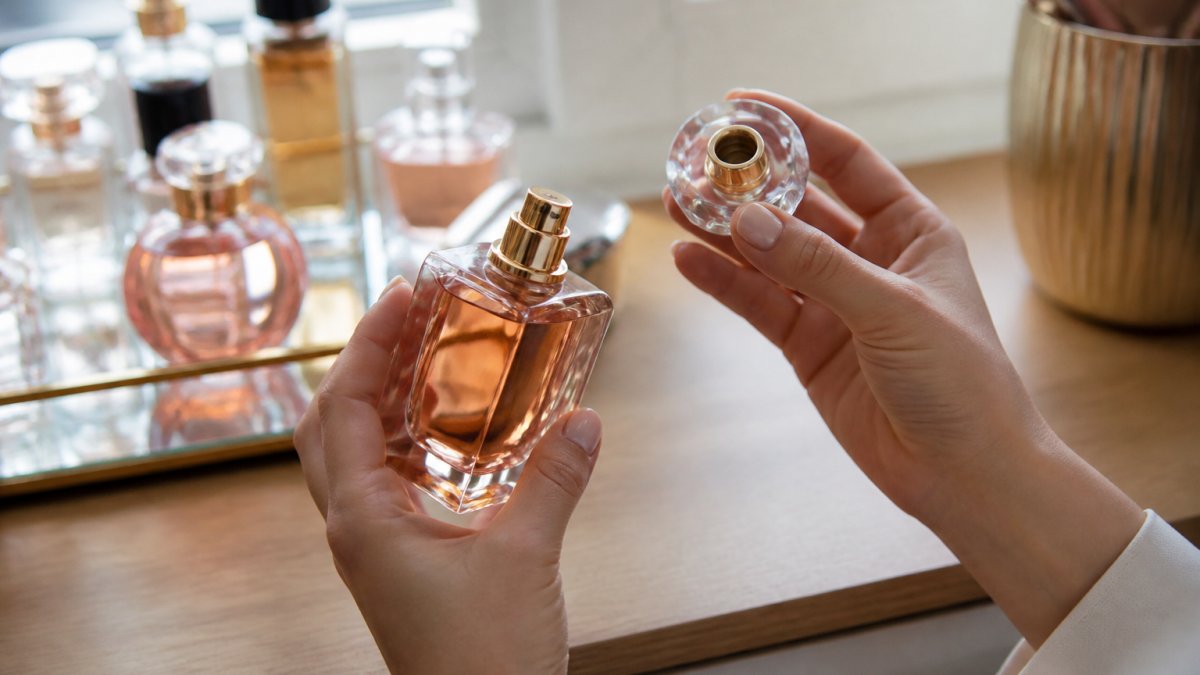
The bottle is where fakes get expensive to hide. Real luxury glass is heavy, clear, and free of bubbles or seams. Hold it up to the light and look closely.
Check the cap fit next. A genuine cap sits flush and closes with a soft, solid click. A fake cap often wobbles, sits crooked, or falls off.
Then test the sprayer. A quality atomizer delivers a fine, even mist with one smooth press. A weak, spitting, or dripping sprayer is a red flag.
Bottle weight is one of the most reliable signals. Counterfeiters use thinner glass to cut costs, and you can feel the difference in your hand before you even spray.
3. Check Labels, Printing, Spelling, and Logos Against Official Imagery
Labels are where small errors become obvious. Pull up the brand's official product page and compare side by side. Do not rely on memory.
Look for these problems:
- Misspelled words, including on the box and the insert
- A logo that is slightly stretched, off-center, or the wrong shade
- Label edges that peel, bubble, or sit crooked
- Font that looks bolder, thinner, or spaced differently
- A barcode that will not scan or points to the wrong product
Color accuracy matters more than most people expect. Print a brand's signature shade wrong and the whole bottle reads as off, even to a casual eye.
4. Check Perfume Authenticity by Barcode and Serial Number
A batch code is a short alphanumeric production code stamped or printed on the bottle base, the outer box, or both. Buyers often use it to judge freshness and to cross-check what a seller claims about stock age.
A key point is how the mechanism works. A batch code is not a security feature. It is a production label, and production labels are visible on every legitimate unit sold. A counterfeiter who buys one genuine bottle can photograph the code and reprint it on thousands of fake boxes. The code will look correct, match between bottle and box, and return a valid date in a lookup tool, because the code itself is real. What is fake is everything the code is attached to.
That is why batch-code tools have a narrow job. Some of them read the code and return a production date or a "valid" flag. They generally do not verify the liquid, the glass, the atomizer, the seller, or the supply chain. A tool that says a code is valid tells you the code exists in a database. It does not tell you the bottle is genuine.
Use the code as one data point, and interpret each outcome carefully:
- Code matches between bottle and box: weak positive. Counterfeiters copy codes precisely because buyers check this.
- Code returns a plausible production date: weak positive. It confirms the code format is real, not that the unit is.
- Code returns nothing: a question, not a conviction. Older stock, regional packaging, tester bottles, and reformulation-era units can fail lookups for innocent reasons.
- Code returns a date that contradicts the seller's claims: a strong negative. If the seller says "new 2026 stock" and the code decodes to 2019, that is a concrete inconsistency worth acting on.
- Code is missing, scratched off, or unreadable: a strong negative on a current product. Legitimate current stock should carry a readable code.
Watch out: a valid-looking code is the single most common reason buyers talk themselves into a fake. Treat a clean code result as permission to keep checking, never as a finish line. When a code check and a physical check disagree, say, the code is valid but the glass is thin and the sprayer spits, the physical evidence usually wins, because physical construction is expensive to fake and codes are free to copy.
A common pattern among experienced buyers is to run the code last, after the box, bottle, label, and seller have already been assessed. That order keeps the code in its proper role: a tiebreaker and a freshness check, not a verdict.
5. Perfume Authenticity Check Online Free: Tools and Their Limits
Free online tools are useful, and they are also oversold. Most of them do one narrow job: they read a batch code and return a date.
What they cannot do:
- Confirm the liquid inside the bottle
- Detect a copied code on a fake box
- Verify the seller or the supply chain
- Account for regional packaging differences
So treat a "valid" result as one green light among several, never as a finish line. A tool that says a code is valid tells you the code exists. It does not tell you the bottle is genuine.
The stronger approach is to combine tools with the physical checks above. When a code check and a visual check disagree, the physical evidence usually wins.
6. How to Verify Authentic Luxury Perfume Online Before You Pay
Buying online removes your ability to hold the bottle, so verification shifts to two things: the seller's legitimacy and your ability to confirm the product directly with the brand. Most fake-perfume purchases go wrong at the seller layer, not the bottle layer, because the buyer never asked a question the seller could not answer convincingly.
Work through this pre-purchase sequence in order. Each step is designed to produce evidence you can act on, not just a feeling.
Step 1, Confirm the seller's channel. An authorized retailer can usually show proof of authorization or explain their supply relationship. A marketplace reseller often cannot, which is not automatically disqualifying but shifts more weight onto the physical checks. Ask directly: "Are you an authorized retailer for this brand, and can you confirm the source of this unit?" A vague or defensive answer is itself information.
Step 2, Compare the listing to official imagery. Pull up the brand's own product page for the exact concentration, size, and version. Compare the bottle shape, cap, label placement, font, and box design side by side. Do not rely on memory.
Step 3, Pressure-test the price. A steep discount on a current designer fragrance is the oldest warning sign in the category. Steep discounts on current designer fragrances are a common warning sign. Discounts on discontinued, older-batch, or tester stock can be legitimate, but the seller should be able to explain why the price is low.
Step 4, Read the return and payment terms before you pay. A real return policy is specific: who pays return shipping, what condition is required, and how long you have. Payment protection matters too, a payment method with a dispute process gives you recourse if the bottle arrives wrong. A seller who buries or omits these terms is telling you something.
Step 5, Ask the batch-code question before checkout. Request the batch code and a photo of the bottle base. A legitimate seller will usually provide it. A seller who dodges the question, sends a stock photo, or claims the code is "not available" on a current product is raising a concrete inconsistency you can weigh.
Step 6, Confirm directly with the brand when checks are inconclusive. This is the step most buyers skip. If the seller's answers, the photos, and the code check leave you uncertain, contact the brand's customer service or an authorized retailer directly. Provide the product name, concentration, size, batch code, and clear photos of the bottle base, label, cap, and box.
Step 7, Decide with a confidence level, not a single clue. Strong evidence includes a seller who answers sourcing questions in writing, packaging that matches official imagery for the exact version, and a brand or authorized retailer confirming the code and packaging. Weak clues include a valid batch code alone, a perfect box, or a low price with a plausible story.
Watch out: a seller who invites batch-code and sourcing questions is not automatically safe, but a seller who dodges them is a concrete reason to stop. The goal is not to find one proof, it is to build enough consistent evidence that the risk is acceptable.
When you are ready to buy, choose a seller who answers these questions before you order rather than after.
7. How to Avoid Fake Perfume Online: Seller Red Flags and Safe Buying Habits
The final layer is behavior, yours and the seller's. Safe buying habits catch what a single inspection cannot.
Red flags worth walking away from:
- Prices far below the brand's own
- No physical business details or contact information
- Pressure tactics like countdown timers on "limited stock"
- Stock photos instead of real product photos
- A return policy buried or missing entirely
On the scent itself, judge how it develops. Fragrance typically opens with top notes, settles into middle notes, and finishes on base notes over hours. A fake often smells sharp and alcohol-heavy at first, then fades fast. Legitimate variation exists between product versions and bottle sizes, so compare like with like.
If a purchase does go wrong, act quickly. Keep the packaging, photograph everything, and check the seller's return terms before you open a dispute. Our step-by-step guide on how to return online purchases walks through the process if a bottle arrives damaged or does not match the listing.
| Check | What It Catches | Reliability |
|---|---|---|
| Outer box quality | Cheap materials, poor print | Medium |
| Bottle and sprayer | Thin glass, weak atomizer | High |
| Labels and logos | Spelling, color, font errors | High |
| Batch code | Freshness, copied codes | Low alone |
| Seller checks | Source and recourse | High |
Counterfeit fragrance is a real problem, and no single check solves it. The answer is a layered habit: inspect the box, feel the bottle, compare the label, run the code, and vet the seller before you pay. Choose Vanelys Trading for carefully selected inventory, and shop with confidence.
Frequently Asked Questions
Can a perfume batch code confirm that a fragrance is authentic?
No, a matching batch code alone does not prove authenticity. Batch codes mainly indicate production date or product freshness, and counterfeiters can copy a real code onto fake bottles. Use the code as one clue alongside packaging quality, bottle construction, label accuracy, and seller reputation. If the code is missing, mismatched, or the seller cannot explain it, treat that as a warning sign and ask the brand directly before buying.
Can I check perfume authenticity online for free?
Yes, several free online tools let you enter a batch code or serial number to see a manufacturing date. These tools are a useful first filter, but they cannot confirm a bottle is genuine on their own. Combine the result with a hands-on check of the outer box, bottle weight, cap fit, sprayer quality, and label printing. For definitive confirmation, contact the brand's official customer service with photos and the code.
What should I check when buying luxury perfume online?
Start with the seller: look for an authorized retailer, a clear return policy, and payment protection. Then compare the listing photos with official brand imagery, checking label spelling, logo placement, and bottle proportions. Ask for the batch code before purchase if possible. After delivery, inspect the seal, cap fit, sprayer, and scent development over the first hour. If anything seems off, stop using it and request a return.
How do I spot a fake perfume from the scent alone?
Scent is a helpful clue but not a reliable standalone test. Fake perfume often opens with a sharp alcohol smell that fades quickly, lacks the layered top, middle, and base notes of the genuine fragrance, and disappears within an hour. Genuine luxury perfume develops gradually and lasts longer on skin. Because scent perception varies and legitimate versions can differ slightly, always pair a scent check with packaging, bottle, and batch-code verification.
